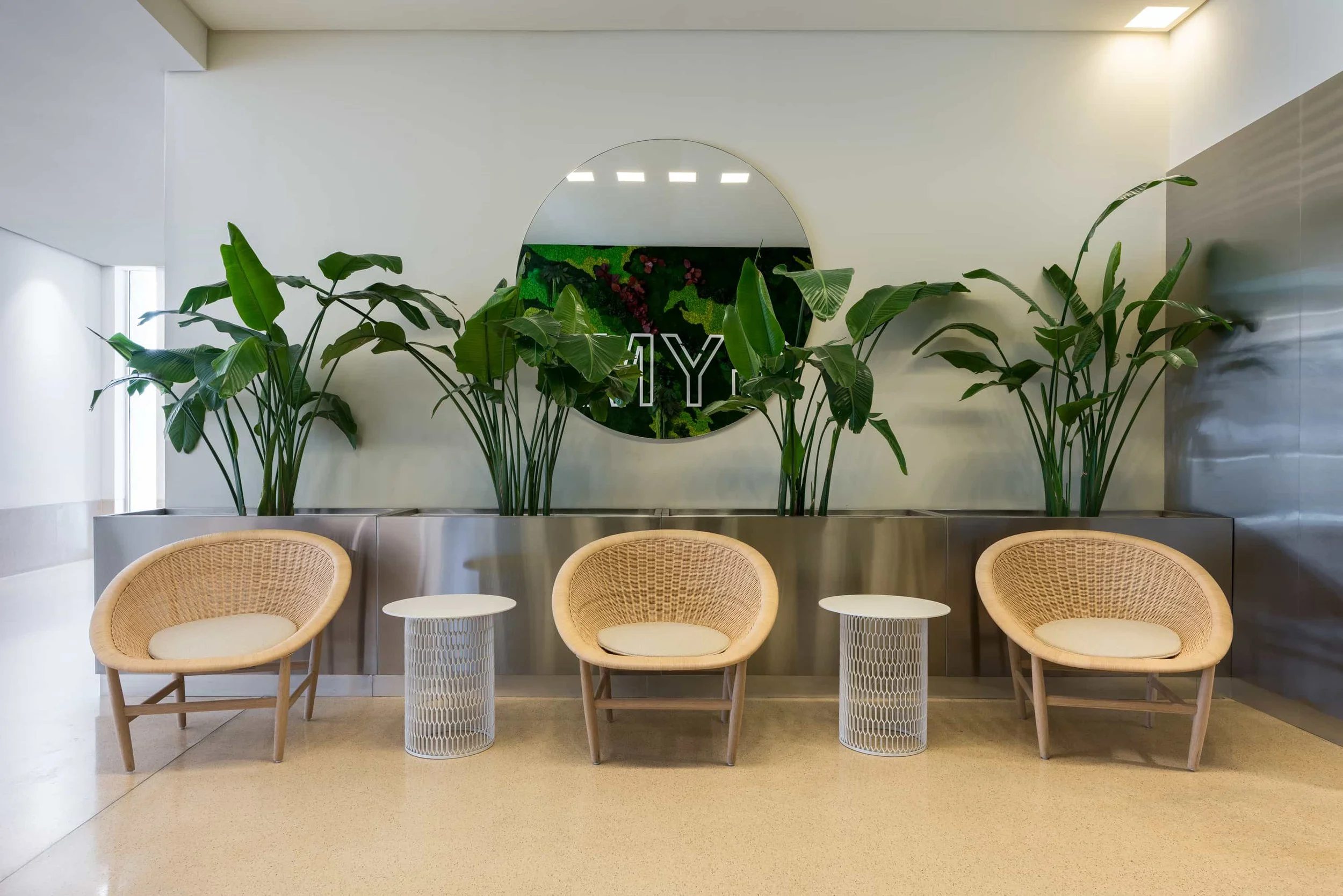
a gym entrance lobby designed by Biofilico in Doha, Qatar
Author: Matt Morley, WELL Advisor (2025 + 2026) · Fitwel Ambassador · TEDx speaker
What Should a Hotel Wellness Amenity Include in 2026?
Not that long ago, the hotel gym used to be enough. A handful of treadmills, a cable machine, some dumbbells and an exercise mat, plus a shelf of small towels and a bowl of apples. For a long time, too long I’d argue, that ticked the ‘wellness box’ for most hotel operators — and most guests simply accepted their fate.
The question I'm now most commonly asked at the start of a hotel wellness brief however is some version of: what should we actually include? This suggests a substantial shift in thinking.
My honest answer is that it depends — on the property scale, the target guest, the operator's ambitions, and the competitive landscape in that specific market. But there's a more useful way to frame it: rather than asking what to include, start by asking what a guest who genuinely prioritises their health now expects from a hotel stay. That guest is not a niche anymore. They're increasingly the primary customer for mid-to-upper-tier hospitality.
As a result, there is now a wide playing field in front of us, which is the subject of this article.
The shift from amenity to offer
A handful of hotel brands have redefined what the wellness brief looks like at the top end, and my sense if that they're worth covering here, even if you're not building at that scale — because their logic filters down.
Equinox Hotels built the most explicit version of this well-hotel genre: a fitness and performance philosophy that was embedded into every aspect of the hotel, from the 60,000 square foot gym and spa at Hudson Yards to guestrooms engineered around sleep quality, with total soundproofing, blackout systems, and technology centralised through a bedside tablet that controls lighting, temperature and privacy.
Their positioning — "performance luxury" — deliberately reframes wellness away from relaxation and towards measurable physical outcomes. It's a brand bet that a growing segment of luxury travellers wants a hotel that actively supports their training, sleep and recovery, not one that simply doesn't get in the way of it.
SIRO Hotels (Kerzner International's disruptor brand, now operating in Dubai and Porto Montenegro) takes a similar philosophy and structures it around five explicit pillars: fitness, recovery, nutrition, mindfulness and sleep.
What's notable about SIRO from a design standpoint is how thoroughly those pillars are translated into spatial decisions. Guestrooms include recovery equipment, stretching bars, and smart curtains synced with guests' circadian rhythms.
A television or projector streams wellness and fitness content while ‘The Recovery Lab’ includes a Himalayan salt room, cold plunges, infrared saunas, cryotherapy chambers and relaxation rooms with massage chairs.
Nutrition is treated as an amenity in its own right, with an extensive health bar menu with functional supplements and a modular restaurant menu designed to accommodate an impressively wide range of dietary preferences.
Wake BioHotel in Medellín, Colombia, approaches the brief from a different angle — smaller scale, Latin American market, but equally deliberate in its positioning. Their longevity-focused concept integrates contrast therapy, spa, and a dedicated longevity club (Sastra) within a hotel that positions itself explicitly as a living ecosystem for self-care.
What Wake demonstrates is that a performance wellness concept doesn't require a 60,000 square foot footprint or a global brand behind it. With the right spatial logic and a coherent concept narrative, it works at boutique scale too.
These three properties represent different points on a spectrum — but they share a common logic: wellness is not a department, it's a design philosophy that runs through the entire guest experience, meaning it is a combination of hardware and software, amenities and operational standards.
The five components that matter most
For most hotel briefs — outside of the ultra-premium performance hotel category at least — the pertinent question is now how to build a coherent, commercially credible wellness offer within realistic spatial and budget constraints.
Based on projects across Europe and the Middle East, here's how I think about the five components that make the biggest difference.
1. Fitness — beyond the hotel gym
The baseline expectation is now a well-specified, properly laid-out fitness space with a logical equipment mix, good natural light where possible, and enough acoustic separation to function as a dedicated training environment rather than a corridor with treadmills.
Beyond that baseline, the design decisions that elevate a hotel gym are zoning (separating cardio, strength and functional training areas, perhaps a movement area, or a hybrid training zone too), ceiling height, flooring specification, and equipment quality.
Guests increasingly recognise Technogym, Life Fitness and similar brands as quality signals but there are so many other options available, from Freemotion on the cardio to Watson and GYM80 on the strength machines.
The gym is also, quietly, one of the highest-frequency touchpoints in a hotel stay — many health-focused guests use it daily. I’d argue it deserves proportionally more design investment than it has historically received, but clearly I’m biased.
2. Recovery — the fastest-growing component of the brief
If there's one area where the hotel wellness brief has shifted most dramatically in the last three years, it's physical and mental recovery. Cold plunge pools, infrared saunas, contrast therapy circuits have moved from quirky biohacking novelties to mainstream guest expectations at four and five-star level.
The spatial logic for a recovery area is distinct from a traditional spa: it's more active, more social, often noisier, and requires careful thermal management and a specific materiality — stone, tile, wood, water — to feel credible rather than clinical.
Getting the adjacency right between recovery, fitness, spa and group studios is one of the more consequential layout decisions in a hotel wellness brief nowadays.
3. Sleep environment — the underdesigned element
Sleep is fundamental to our mental and physical performance, especially when on the road, away from our regular bedroom set-up. It's arguably the most impactful wellness intervention available to a hotel, and it's almost entirely delivered through the guestroom rather than a dedicated amenity space.
Blackout systems, acoustic performance, circadian lighting, mattress and bedding specification, air quality and temperature controllability — these are the key sleep design levers, and most hotels don't pull enough of them.
Equinox Hotels built an entire brand position around this. For operators not at that scale, even addressing two or three of these levers consistently across the room inventory represents a meaningful differentiation.
4. Mindfulness and restorative space
Not every guest wants to train, some seek calm and rest instead. A quiet room, a meditation space, a dedicated area for breathwork or yoga — something that offers a restorative counterpoint to the fitness and recovery offer — is increasingly part of a well-rounded hotel wellness brief.
At its most minimal this can be a carefully designed corner of a larger wellness floor. At its most developed it's a dedicated soundproofed studio with specialist acoustic treatment, circadian lighting and a curated material palette. The brief depends on the property, but the absence of any restorative space is now a noticeable gap.
5. Nutrition and F&B integration
SIRO's decision to treat nutrition as a fifth pillar of its brand — with nutritionist access, macro-tailored meals, and a minibar stocked with protein shakes rather than soft drinks — is notable because it's rare.
Most hotels still treat F&B and wellness as entirely separate departments. Closing that gap, even partially, through a health-oriented menu option, a juice bar adjacent to the gym, or a smoothie offering in the fitness space, creates a more coherent guest experience and a stronger wellness narrative.
How to scope the brief at different scales
Not every hotel can build a SIRO Recovery Lab or an Equinox-scale fitness club. The more useful exercise is calibrating the brief to the property.
A 40-room boutique hotel in a coastal location needs a well-specified outdoor fitness terrace, a compact but thoughtfully equipped indoor gym, access to contrast therapy (even a single cold plunge and sauna pairing can anchor this), and guestrooms with proper blackout and acoustic performance. That's a coherent wellness offer at a realistic scale.
A 200-room city hotel targeting business and leisure travellers needs a proper fitness floor, a recovery circuit, a yoga or movement studio for programming, a sleep-optimised room category, and F&B that supports a health-conscious guest. WELL or Fitwel certification for the building would add a third-party validation layer that increasingly matters to corporate travel bookers.
A resort with genuine wellness ambitions — and the space to match — can build toward the full five-component offer, with each element properly sized, spatially separated, and connected by a coherent guest journey from arrival to departure.
The design consultant's role in all of this
The brief for a hotel wellness amenity rarely arrives fully formed. Most operators know they need more than a gym, but the space allocation, capital budget, operational model and target guest profile are still being worked out when design conversations begin. That pre-design phase — defining the concept, the space mix, the level of ambition and the design principles that will make the project distinctive — is where specialist input makes the most difference.
Getting the brief right before committing to a spatial layout or equipment specification saves significantly more than it costs. And increasingly, the wellness offer is one of the primary commercial differentiators available to a hotel operator in a crowded market — which makes it worth getting right.
Matt Morley is the founder of Biofilico, a wellness interior design consultancy operating across Europe and the Middle East. He holds WELL Advisor credentials for the Movement and Mind chapters, and is a Fitwel Ambassador. Biofilico works with hotel operators, resort developers and design teams on wellness amenity design, concept development and healthy building strategy.