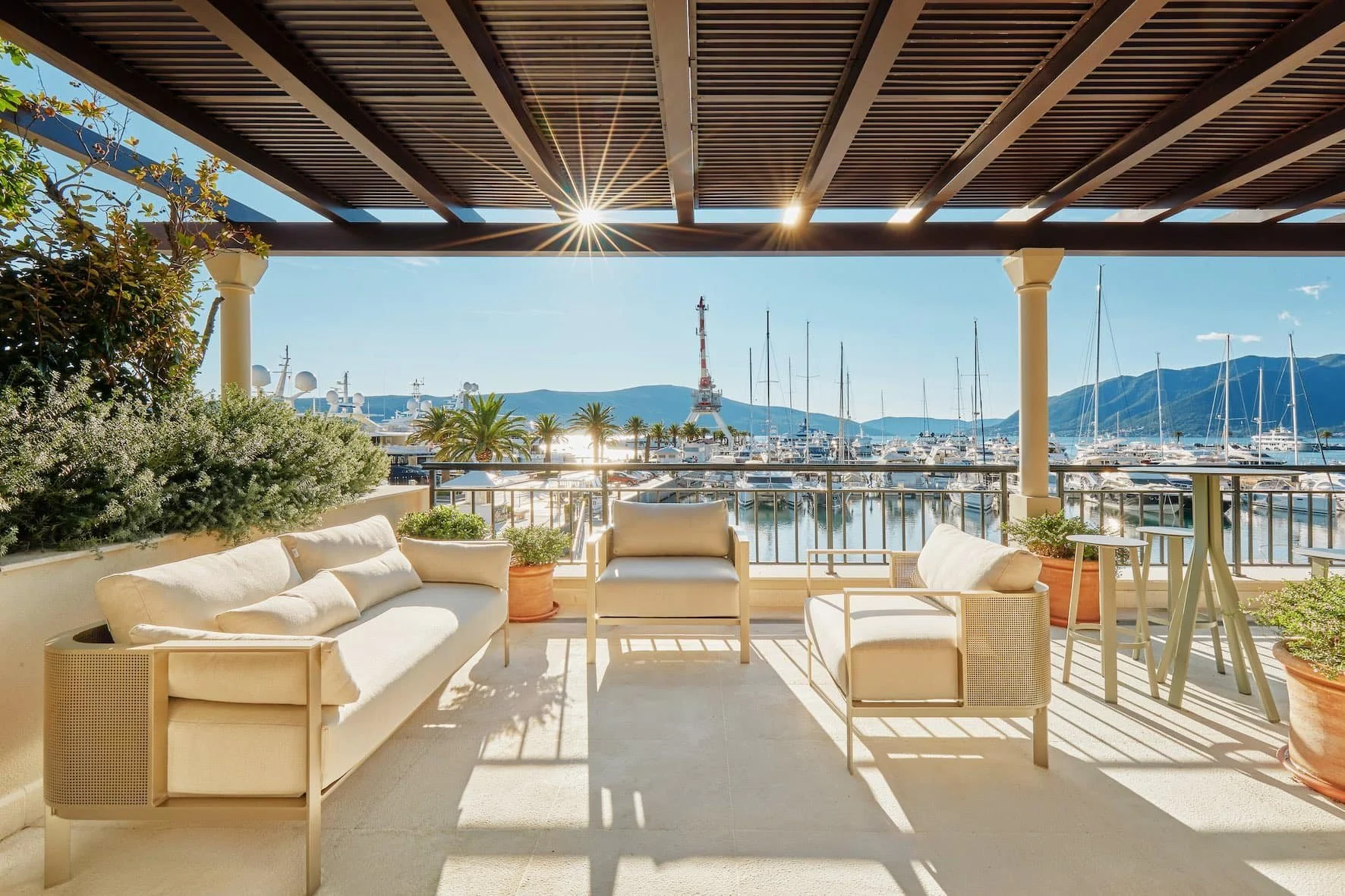
Ozana Business Club terrace at Porto Montenegro, designed by Matt Morley of Biofilico
For much of the last decade, residential wellness has been relatively easy to communicate. A development might offer a gym, swimming pool, spa, yoga studio or landscaped terrace, and these amenities would collectively form the basis of its wellness proposition.
In premium schemes, the list might extend further into hydrothermal facilities, treatment rooms or specialist fitness spaces, but the underlying logic remained largely unchanged: wellness was something added to the residential offer in the form of amenities. That model is now beginning to evolve.
Across the premium residential sector, and particularly in the Gulf, there is a discernible shift away from treating wellness as a discrete amenity category and towards integrating health more deeply into the residential experience itself. The emerging model combines healthier homes, more intentional private and shared wellness environments, and in some cases access to specialist services and expertise that continue beyond the point of sale.
The distinction is important. A wellness residence is not necessarily a home with more equipment or a longer amenities list. Increasingly, it is a home designed to support healthier living every day.
From Visible Amenities to Embedded Performance
Amenities remain valuable, of course. A well-designed gym, spa, pool or recovery space can contribute significantly to the appeal of a residential development and, in the right market, become a meaningful point of differentiation. The issue is not whether such amenities still matter, but whether they are sufficient on their own.
A resident may have access to an excellent wellness club downstairs and still live in an apartment with poor acoustic privacy, weak environmental controls, inappropriate lighting or a bedroom that does little to support sleep. Equally, a development may invest heavily in a spa and yet leave the quality of the home itself relatively untouched by the wellness narrative.
The more sophisticated proposition is therefore one in which health is considered across the entire residential environment. Air quality, water, lighting, acoustics, material specification, sleep conditions, thermal comfort, access to nature and the relationship between indoor and outdoor space all become part of the wellness strategy rather than remaining purely technical or aesthetic concerns.
This is the point at which the building itself starts to become part of the wellness intervention.
The Rise of the Wellness-Ready Residence
The next layer in this evolution is the idea of the wellness-ready home.
Rather than attempting to reproduce every possible wellness function within each residence, developers can create a more flexible infrastructure capable of supporting different levels of personalisation over time.
In higher-end projects, that might mean provision for private treatment, meditation or recovery spaces; enhanced environmental controls; integrated health technology; or the ability to add infrared, sauna, cold-plunge or other specialist installations according to resident preference.
The significance lies less in the equipment itself than in the fact that the home has been conceived with these possibilities in mind from the outset.
That is a different proposition from adding wellness retrospectively. It allows residential design to anticipate changing lifestyles and gives owners a degree of flexibility as their priorities evolve. It is also particularly relevant in long-term ownership markets, where a residence may need to support different generations, family structures and health priorities over many years.
Shared Wellness Still Has a Critical Role
None of this diminishes the importance of shared wellness infrastructure. If anything, the strongest emerging models appear to be those that establish a clearer and more intelligent relationship between what belongs inside the home and what is better delivered communally.
Not every residence needs its own advanced fitness environment, hydrothermal suite, treatment room or longevity clinic. In many cases, these facilities are more effective when concentrated within a sophisticated shared wellness environment where they can benefit from better equipment, specialist operations and professional support.
This allows the residence itself to focus on healthy everyday living while the wider development provides access to more specialised functions.
The result is not a competition between private and shared wellness, but a more coherent ecosystem in which each layer performs a distinct role.
Services Are Becoming Part of the Product
The most significant shift, however, may be the move beyond physical design altogether.
A number of emerging residential concepts are beginning to incorporate wellness services as part of the proposition: practitioners, health assessments, nutrition support, coaching, treatments, personalised programmes and longevity-focused expertise. In these models, wellness is no longer confined to the specification of the home or the presence of shared facilities. It becomes an ongoing service relationship with the resident.
This has important implications for developers and operators.
A conventional amenity is largely static once delivered. A service proposition, by contrast, can evolve over time, respond to individual needs and create a much more dynamic relationship between the development and its residents. It also begins to blur the traditional boundary between real estate, hospitality and wellness operations.
For some projects, particularly branded residences and premium mixed-use developments, that convergence may become an increasingly important source of differentiation.
Three Layers of Wellness Living
At Biofilico, we see the emerging wellness residence through three interconnected layers.
The first is the healthy home: the environmental foundation created through air, water, materials, lighting, acoustics, sleep, nature and thermal comfort.
The second is the wellness environment: spaces designed to support more intentional wellbeing, whether through movement, recovery, hydrothermal experiences, meditation, treatment or outdoor wellness.
The third is the wellness service layer: the expertise that supports the resident over time through assessment, coaching, nutrition, treatments, practitioners, personalisation and longevity-focused programming.
The most complete propositions connect all three, but there is no requirement for every project to deliver each one at maximum intensity. In fact, one of the most interesting characteristics of the emerging market is precisely the variety of models now appearing.
There Is No Single Wellness-Residence Formula
Recent projects across the Gulf demonstrate just how diverse the category is becoming.
Some developments are being shaped by specialist clinical or longevity brands. Others are driven by healthy-building performance, regenerative design or nature-led masterplanning. Some place greater emphasis on private wellness infrastructure, while others focus on shared facilities, services or more accessible wellness-led positioning.
This diversity matters because it suggests that wellness living is developing into a genuine residential category rather than a single design trend.
It also means developers need to resist the temptation to imitate whatever happens to be most visible in the market. A scheme built around landscape, outdoor living and community wellness should not necessarily adopt the same strategy as an ultra-premium branded residence connected to specialist longevity services. Equally, a compact urban development may need to make very different choices from a destination-scale masterplan.
The question is not which wellness features are currently fashionable, but which combination is credible for the asset, the location and the intended resident.
Nature as Wellness Infrastructure
One of the more useful developments in this broader conversation is the recognition that wellness infrastructure does not always need to be highly technical.
Landscape, shaded outdoor environments, walking routes, courtyards, planting, water, gardens and stronger indoor-outdoor relationships can all play a substantial role in supporting healthier residential living. In larger developments, these elements can become part of the daily wellness experience in a way that is often more natural and more frequently used than specialist facilities.
This is particularly relevant where the scale of the project allows wellness to extend into the public realm and community environment.
In that context, landscape should not be seen simply as visual amenity. It can support movement, social interaction, mental restoration, family life and everyday contact with nature. That gives it a more strategic role within the residential proposition.
A Gulf-Specific Response
This need for strategic specificity is particularly important in the Gulf.
Global wellness trends provide useful precedents, but residential design in the region needs to respond to its own climatic, cultural and social realities. Hospitality and entertaining remain fundamental to residential planning.
Privacy operates at different levels between individual, family and guest spaces. Multi-generational households require more nuanced relationships between shared and private environments. Heat, solar exposure, dust and seasonal conditions affect both indoor environmental quality and the practical usability of outdoor spaces.
At the same time, long-term family ownership means that flexibility and adaptability can be especially important.
A successful Gulf wellness residence therefore cannot simply import an international formula. Its wellness strategy needs to reflect how people actually live in the region, how they use their homes, how they receive guests, how family structures operate and how indoor and outdoor environments perform throughout the year.
From a Longer Amenities List to a More Coherent Proposition
For developers, this is perhaps the most important implication.
The next generation of wellness residences is unlikely to be defined by who can assemble the longest amenities schedule. A more compelling proposition is one in which the different components work together coherently.
The home itself should provide a healthier environmental foundation. Private wellness provision should offer appropriate levels of personalisation. Shared facilities should concentrate specialist functions where they add most value. Services should extend the proposition over time where there is a credible operational model. Landscape should support everyday wellbeing rather than operating only as a visual backdrop.
When these elements are aligned, wellness becomes part of the residential concept rather than a separate package attached to it.
What This Means for Residential Developers
The practical consequence is that conversations around residential wellness need to start earlier.
Before discussing equipment or individual facilities, developers should be asking what wellness actually means for the intended resident profile and how that should be expressed across the project. Which health priorities belong within the residential specification? Which activities are better delivered through shared spaces? What role should landscape play? Is there a credible services layer? How much personalisation is appropriate? Which ideas genuinely strengthen the development, and which simply add cost or complexity?
These are fundamentally strategic questions.
They are also much easier to answer during briefing and concept development than once layouts, specifications and operational assumptions have already been fixed.
Final Thoughts
The residential wellness market is moving from a relatively simple amenities proposition towards a more integrated model of wellness living.
The strongest emerging projects are not defined by a single technology, certification or collection of features. Instead, they connect healthier buildings, restorative interiors, dedicated wellness environments and, where appropriate, specialist services in a way that feels coherent with the wider residential proposition.
Not every development needs to become a longevity residence, nor does every home need its own private wellness suite.
The opportunity lies in understanding which interventions genuinely improve the quality of everyday residential life, and in integrating them with enough discipline that wellness becomes part of how the project works rather than simply how it is marketed.
That is the shift from a home with wellness amenities to a genuine model of wellness living.
Written by Matt Aspiotis Morley, TEDx speaker and IWBI Well Building Advisory (2025 + 2026)
FAQ Section
What is a wellness residence?
A wellness residence is a home or residential development in which health and wellbeing are integrated into the residential experience through a combination of healthy building principles, dedicated wellness environments and, in some cases, specialist services.
How is a wellness residence different from a development with wellness amenities?
Traditional wellness amenities tend to focus on facilities such as gyms, pools and spas. An integrated wellness residence also considers the performance of the home itself, including air, water, light, acoustics, materials, sleep and thermal comfort.
Do wellness residences need private saunas, gyms or cold plunges?
No. Private wellness facilities can form part of the proposition, but they are not a prerequisite. In many cases, the strongest model combines a healthier home with access to more sophisticated shared wellness facilities.
What are the main layers of wellness living?
Biofilico identifies three principal layers: healthy homes, wellness environments and wellness services. The balance between them should depend on the project, its positioning and the needs of the intended residents.
What role can wellness services play in residential development?
Services can extend the proposition beyond the physical real estate through access to practitioners, health assessments, coaching, nutrition, treatments, personalised programmes and longevity-focused expertise.
Is wellness residential design only relevant to luxury projects?
No. Luxury developments are currently leading many of the more advanced innovations, but wellness-led positioning is increasingly appearing in smaller and independent residential projects as developers look for more meaningful forms of differentiation.
Planning a wellness-led residential or branded residence project?
Biofilico works with developers and design teams to define wellness strategy, healthy-home principles, private and shared wellness environments, and the wider resident wellbeing proposition from the early stages of design.
Explore our residential wellness services or get in touch to discuss your project.