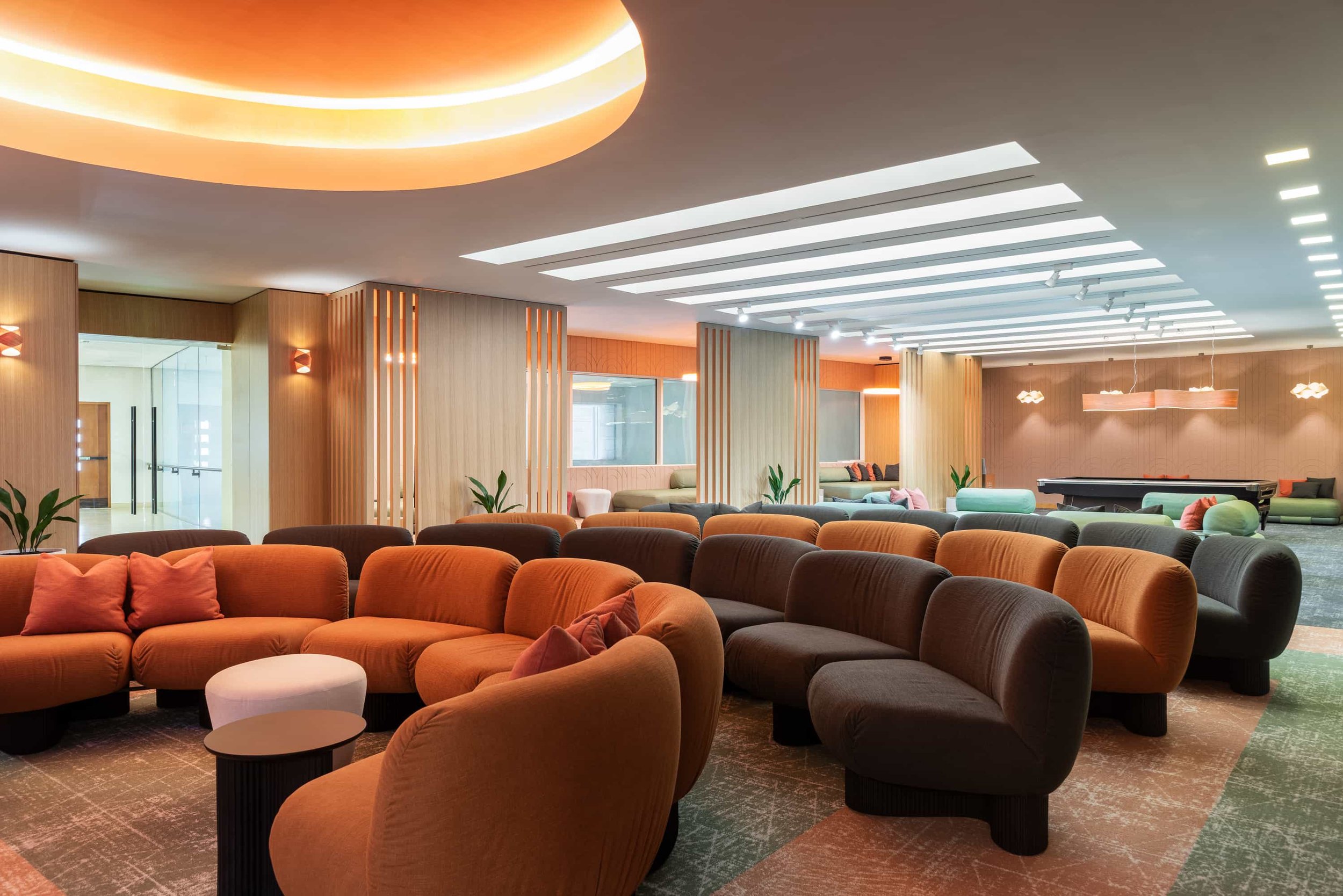
student lounge - carnegie mellon university qatar by biofilico
How to Design a Student Wellbeing Space That Actually Gets Used
There is no shortage of intention when it comes to student wellbeing on university campuses right now. Universities are taking student wellbeing extremely seriously, with many investing in specialist support structures and interventions, and thinking critically about the best ways to reconfigure their estates and campuses to enrich student wellbeing. Budgets are being allocated. Rooms are being designated. Wellness is appearing in estates strategies across higher education in the UK, Europe and the Middle East.
And yet the pattern I encounter most often when a university contacts Biofilico about a wellbeing space brief is this: a room exists, it has been given a name — wellness room, mindfulness room, reflection space, quiet room — and it isn't being used in the way anyone hoped.
The physical space was created. The intention was right. But somewhere between the decision to invest and the finished room, the design brief got vague, the specification got generic, or the activation wasn’t delivered fully and the result is a space that students walk past rather than into.
This article is about why that happens and what to do differently.
The brief problem
Most campus wellness spaces fail at the brief stage, not the design stage. The design team — whether an in-house estates team or an external architect — is asked to create a "wellness room" without a sufficiently specific articulation of what that means, who it is for, how it will be used and what it needs to feel like.
The result is typically a room that tries to be everything: a meditation space, a quiet study area, a drop-in counselling waiting room and a social decompression zone simultaneously. Spaces designed for multiple conflicting uses without clear spatial logic tend to serve none of them well.
Student health and wellness is no longer solely focused on providing care for students with physical or mental illness. These spaces are increasingly incorporating programmes and spaces that are more holistic and inclusive, with dedicated areas for massage and aroma therapies, multipurpose rooms and sensory spaces for respite and quiet not otherwise offered on campus. That breadth of ambition is a positive development — but it requires a more sophisticated brief, not a more generic one.
The first job on any campus wellbeing brief is to be specific about what the space is for. And that requires understanding the difference between the space types that are often conflated.
Understanding the space types
These terms are used interchangeably in estates discussions but they describe meaningfully different briefs:
A mindfulness or meditation room is a dedicated space for contemplative practice — seated or lying, quiet, with no incidental traffic. It needs excellent acoustic isolation, controllable low-level lighting, a considered material palette that signals calm, and a layout that can accommodate both individual and small group use. Access needs to be easy and low-friction — a mindfulness room that requires booking three days in advance via a portal will not be used.
A wellness room is a broader term that typically covers a range of restorative and self-care activities — breathwork, stretching, light yoga, brief rest. It needs more floor area than a mindfulness room, height-adjustable lighting, a hard-wearing but comfortable floor surface, and enough acoustic separation to allow movement without disturbing adjacent spaces.
A reflection or prayer space has specific requirements around orientation, symbolic neutrality, floor surfaces for prostration, ritual washing adjacencies, and a completely different spatial logic from a secular wellness room. Conflating these briefs — as many campuses do — produces spaces that serve neither community well.
A mental health drop-in or quiet room adjacent to student counselling services has specific clinical adjacency requirements, safeguarding considerations, and a need for discreet access that distinguishes it from a general wellness space. The design must reduce stigma around entering while maintaining the confidentiality that users need.
Getting this distinction right in the brief — deciding which space type or combination of types is actually needed — is the single most consequential decision in a campus wellbeing project. It shapes every subsequent design decision.
The five design principles that make the biggest difference
Once the brief is correctly set, the design decisions that determine whether a wellbeing space actually works come down to five variables.
1. Sensory environment
A wellbeing space should feel immediately and perceptibly different from the corridors and study spaces around it. That shift is created through a combination of acoustic treatment, lighting quality, material palette, scent and thermal comfort — working together rather than in isolation. A room with good acoustic panels but harsh fluorescent lighting still feels stressful. A room with warm lighting but hard reflective surfaces still feels loud.
The sensory environment needs to be considered holistically, with each element reinforcing the intended atmospheric effect. Natural materials — timber, cork, linen, stone — create a qualitatively different sensory experience from synthetic alternatives and are worth specifying even at a modest budget level.
2. Acoustic performance
Universities are investing in spaces that support students' mental wellbeing — counselling centres, quiet rooms, spaces for meditation — and the role of space, light, sound and décor in student learning and healthy living is gaining serious attention. Sound is the most frequently overlooked variable in this investment.
A quiet room that isn't acoustically quiet is a design failure. This means specifying acoustic performance as a hard requirement — not as an aspiration — from the brief stage.
Wall and ceiling treatment, floor finish, door seals, mechanical noise from HVAC, sound bleed from adjacent spaces: all of these need to be addressed explicitly. Acoustic modelling at the design stage costs a fraction of what remedial acoustic treatment costs after occupation.
3. Lighting controllability
Controllable lighting — the ability for the occupant to adjust the intensity and colour temperature of the space — is one of the highest-impact design decisions available at low additional cost. A wellbeing space that has only one lighting state is a space that will be used only when that state matches the user's need.
A space with a simple dimmer and a warm/cool option can serve morning energy practices, midday focus sessions and evening wind-down use with the same physical configuration.
Circadian-aware lighting systems, which shift automatically through the day toward warmer, lower tones in the evening, are the more sophisticated version of this and increasingly accessible even at modest specification budgets.
4. Furniture flexibility
Students value adaptable learning environments, collaborative social areas, inclusive facilities, and spaces that foster wellbeing. A wellbeing space that has fixed furniture cannot adapt to the range of uses students actually bring to it.
Lightweight moveable seating, stackable cushions and floor-level options — supported by discreet storage — allow the space to reconfigure for individual use, small group breathwork, a visiting practitioner session or a quiet study period without requiring estates intervention. The temptation to specify heavy, expensive furniture that photographs well but doesn't move is a recurring brief error.
5. Access and discovery
A wellbeing space that is hard to find, requires advance booking, has restricted opening hours or is located in a building students associate with clinical services will not attract the students who most need it. Location matters enormously — a wellbeing room positioned on a circulation route that students use daily, near a café or social space, is used more frequently than an identical room tucked behind the estates office.
Access should be as frictionless as possible: a simple sign-in, a door code available to all enrolled students, or open-access hours alongside bookable sessions. The user journey from the moment a student decides they need a quieter space to the moment they are sitting in one should involve as few steps as possible.
What the estates team needs to consider before briefing
Beyond the design itself, there are three operational questions that shape the brief and that are best resolved before design work begins.
Supervision and safeguarding. A dedicated wellbeing space has different supervision requirements from a library or study room. Who is responsible for the space? Is it staffed or unsupervised? What happens if a student in distress uses it? These questions don't require clinical answers at the design stage, but they do affect adjacency decisions, sightline considerations and the relationship between the physical space and the student services team.
Integration with student services. A wellbeing space that operates in isolation from the wider student support ecosystem — counselling, health services, wellbeing programmes — is less effective than one that is physically or programmatically connected to it. Even a simple referral pathway or a noticeboard that links the physical space to available support services creates a more coherent offer.
Programming. An empty room with good acoustics and warm lighting is still an empty room without activation. Even a light programme — a weekly guided meditation, a visiting breathwork practitioner, a monthly wellness talk — transforms how a space is perceived and used. Programming should be budgeted alongside the capital design investment, not treated as an afterthought once the space opens.
What we've learned from delivering these spaces
Having designed student wellbeing environments at Carnegie Mellon University Qatar — including a mindfulness room, student gyms, activity room, staff lounges, study areas and a student lounge — and worked with Karolinska Institutet in Stockholm on a healthy gym space for students at the centre of campus, the pattern that emerges across both projects is consistent.
The spaces that work are the ones where the brief was specific, the sensory environment was designed holistically, the acoustic performance was treated as a non-negotiable, and the access logic was considered from a student user's perspective rather than an estates management perspective. The spaces that struggle are the ones where the brief stayed vague, where generic furniture and standard lighting were specified, and where no one asked the question: would a stressed second-year student actually choose to come here?
That question — would a student actually choose this space over the alternatives available to them — is the most useful design evaluation tool on a campus wellbeing brief. It keeps the student experience at the centre of decisions that can otherwise drift toward institutional logic.
The design of a university campus plays a vital role in expressing an institution's values and academic identity, while creating welcoming environments where students feel they belong. A wellbeing space, done well, does both of those things simultaneously. It expresses a genuine commitment to student health and it creates a room that students actually want to be in.
Getting the brief right is how you ensure the outcome is the second of those things, not just the first.
Matt Morley is the founder of Biofilico, a wellness interior design consultancy operating across Europe and the Middle East. He holds WELL Advisor credentials for the Movement and Mind chapters, he is also a Fitwel Ambassador. Biofilico works with universities, estates teams and student accommodation developers on campus wellbeing space design, healthy building strategy and wellness interior design.